
Home improvement leads: how to get quote-ready homeowners
The best home improvement leads are the ones that cost the least per closed job. Referrals, your Google Business Profile and jobsite signs give you a free base, and paid leads add volume. Judge each channel by how exclusive it is and how much it qualifies the homeowner, then have homeowners describe the project before you call.
Key takeaways
- Judge every lead channel on what it costs per closed job.
- Lead quality comes in four tiers: raw inquiry, contactable, quote-ready, and budget and timeline confirmed.
- Referrals, your Google Business Profile and yard signs are free, but you can't scale them on demand.
- Exclusive leads beat shared ones when their higher contact and close rates make up for the higher price.
- Before you pay a lead vendor, check exclusivity, the credit policy and any volume commitment.
What counts as a qualified home improvement lead?
Lead quality comes in four tiers, and each one answers more of what you'd otherwise find out on the phone:
- A raw inquiry is a name and a phone number, maybe a "call for a free estimate" form with no project details.
- A contactable lead is one you can actually reach. How fast you respond decides much of this. When Harvard Business Review studied how companies answer online inquiries, the authors found that "most companies are not responding nearly fast enough."
- A quote-ready lead has described the project: the room, its size, the materials and a rough scope.
- A budget-and-timeline-confirmed lead has also told you a number and a month.
The tier matters more than the price. A $30 shared lead that never picks up the phone costs more per closed job than a $150 exclusive lead that arrives quote-ready. Before you spend on any channel, ask which tier it delivers.
How do you generate home improvement leads without buying them?
For a crew of 1 to 10, the organic channels that work are referrals, your Google Business Profile and visibility at the jobsite. They cost time instead of cash.
Referrals with a system behind them
Plenty of contractors call referrals their best source and have nothing behind the claim. A system means asking every past client within two weeks of final payment, offering something concrete for a referral (a gift card, or a discount on future maintenance), and tracking who referred whom so you can thank them properly. A short list of past clients asked the same way every time will do more than a long list asked whenever you remember. Most referral programs die in the follow-up, not the asking.
Google Business Profile and local search
Your Business Profile is free, and for a search like "remodeler near me" it often shows up before your website does. Google says local results are "mainly based on relevance, distance, and popularity," and that "more reviews and positive ratings can help your business's local ranking." So answer every review, post recent jobs every week and list your service area honestly. Local SEO beyond the profile is slower: expect it to take months before a service page ranks.
Yard signs and jobsite visibility
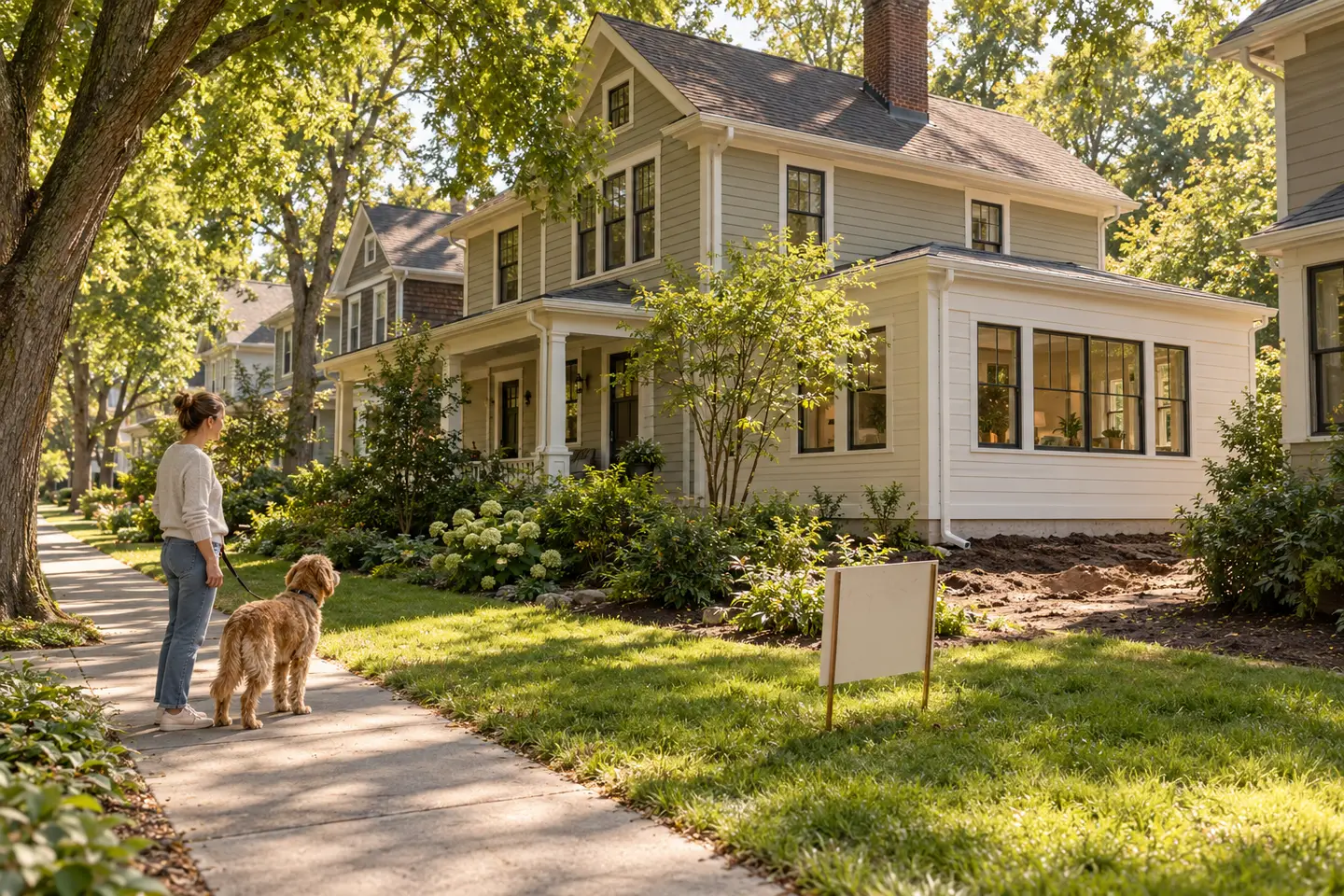
A sign outside a remodel or an addition in a dense neighborhood keeps working that neighborhood for months. Add a QR code or a short URL so neighbors land on your estimate page instead of a generic contact form.
When is it worth buying home improvement leads?
It's worth it when the cost per signed job fits the size of the work you sell. On small jobs it rarely does.
Shared marketplace leads
Lead marketplaces sell the same inquiry to several contractors. Housecall Pro's guide to one of them says pros pay "$10 to over $100 depending on trade, job size, and market," that the marketplace charges "whether or not the job turns into booked work," and that "customers often reach out to multiple pros at once."
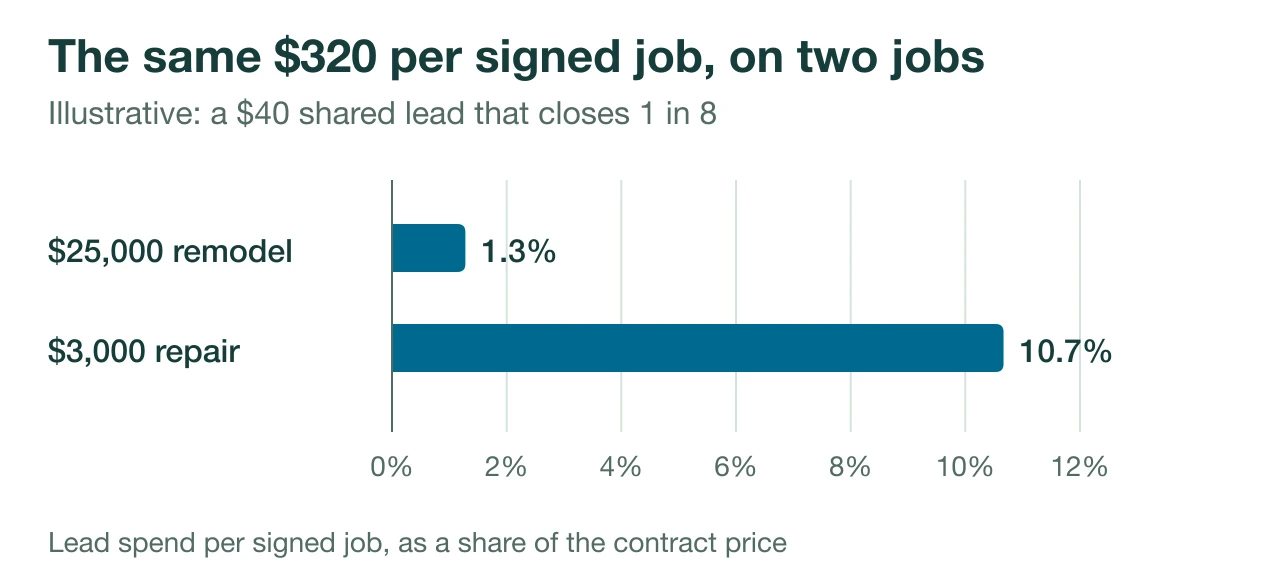
What matters is the cost per signed job. If a shared remodel lead costs $40 and you close 1 in 8, you paid $320 in lead fees for each job you signed. On a $25,000 bathroom remodel, that pencils out. On a $3,000 repair, it usually doesn't.
| Lead type | Typical cost | Close rate you need | Best fit |
|---|---|---|---|
| Shared marketplace lead | $25 to $100 per lead | 1 in 6 to 10 | Larger jobs, $15,000 and up |
| Exclusive vendor lead | $75 to $300 per lead | 1 in 3 to 4 | High-ticket remodels and additions |
| Aged or telemarketing list | $10 to $50 per record | 1 in 20 or worse | Filling a slow week |
These ranges are illustrative. Check each vendor's own pricing page before you commit.
Telemarketing leads and aged lists
Telemarketed and aged leads are cheap per record and expensive per job. The homeowner often never asked for a quote, so your first call is a cold call. Buy them only to fill a slow week.
Red flags in vendor contracts
Check three things before you pay. Do you get credits for bad phone numbers and out-of-area leads? Is the lead really exclusive, or sold to five contractors? Do you have to buy a minimum volume each month? If a vendor won't put its credit terms in writing, walk away. And bought leads still leave the discovery calls to you.
How do exclusive leads compare to shared leads on cost per closed job?
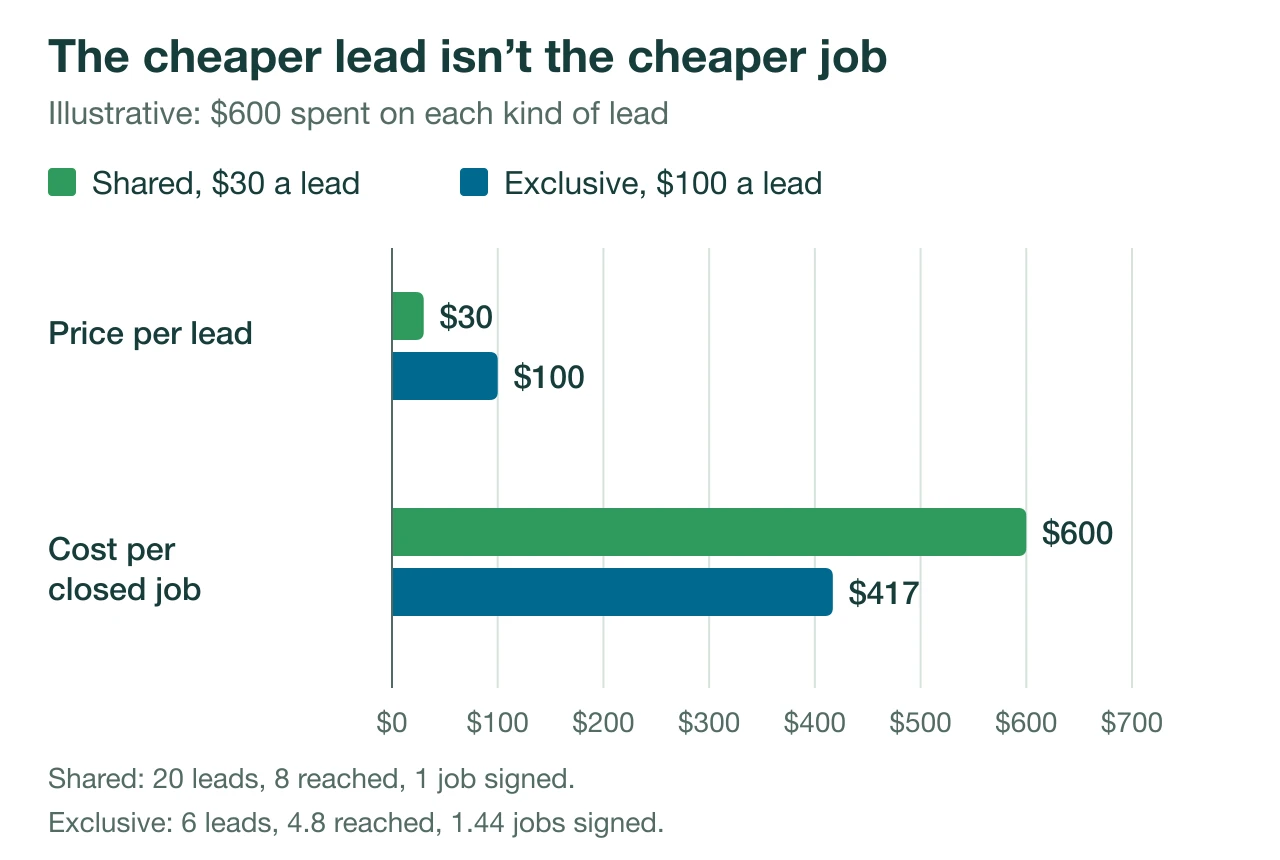
A $30 shared lead looks cheaper than a $100 exclusive one until you run the numbers on contact rate and close rate. The exclusive lead wins whenever it gets answered and closed at several times the shared lead's rates, and it usually does, because nobody else is calling your homeowner the same afternoon.
The two rates that matter: contact and close
Shared leads go to several contractors at once, so the homeowner's phone rings all day and they stop picking up. Expect a low contact rate and a lower close rate, since you're also competing on price with the other bidders. An exclusive lead costs more, but you're the only one calling, so both rates go up. Cost per closed job is the lead cost divided by the contact rate, divided again by the close rate, and that formula is the whole comparison.
Worked example: the same budget on two channels
These numbers are illustrative, not measured. Spend $600 on shared leads at $30 each and you get 20 leads. A 40% contact rate gives you 8 conversations, and closing 1 in 8 of those gives you one signed job, at $600. Spend the same $600 on exclusive leads at $100 and you get 6. An 80% contact rate gives you about 5 conversations, and a 30% close rate gives you about 1.4 jobs, or $417 a job. The exclusive channel comes out ahead per job, and the jobs you win were shopped less on price.
Are free home improvement leads realistic for a small contractor?
Yes, but they're slow. Referrals, yard signs and word of mouth in your neighborhood produce real jobs, but you can't turn the volume up when you want more work, so build on them rather than rely on them.
They come from three places: past-client referrals, your Google Business Profile, and neighborhood talk on Nextdoor or in local Facebook groups. Of the three, the Business Profile is the one worth tending every week. Keep it current and ask every happy client for a review.
Free leads still cost you something. Every inquiry needs a call, questions about scope and a ballpark price before the homeowner decides whether you're worth a site visit. That's your evening instead of a $30 lead fee.
What should you check before signing up with a lead vendor or telemarketing list?
Ask every vendor the same eight questions before you pay a deposit:
- Exclusivity. Is the lead sold only to you, or to three other remodelers as well? Shared leads can be fine at a low price, but get the ratio in writing.
- Credit policy. What counts as a bad lead: a disconnected number, the wrong trade, out of your territory? How long do you have to dispute it?
- Lead age. Some resellers sell inquiries that are weeks old. Ask when the homeowner first got in touch.
- Contact details. Do you get a name, phone, address and project description, or just a scraped form?
- Prequalification. Does anyone ask about budget and timeline, or is it a raw name?
- Volume commitment. Is it month to month, or a contract?
- Replacement terms. Are bad leads credited or replaced?
- Published pricing. Be wary of a vendor that won't put its prices on a page.
On the sales call, ask for a sample lead with real contact information, and ask what share of leads get disputed for credit each month. A vendor who answers both without hesitating is worth a trial. One who dodges isn't.
How do you turn a raw inquiry into a quote-ready conversation?
Move the qualifying questions to before the site visit, and answer the homeowner quickly.
Qualify before the site visit, not during it
Reply the same evening if you can. A homeowner comparing contractors tends to go with whoever answers first with something useful, and a next-day reply can arrive after they've moved on. Your first call should settle three things: the budget range, the timeline, and whether they own the home. Someone who won't share a ballpark budget, or who is "just getting ideas," is shopping for estimates, not hiring. Log every inquiry in one place, even a spreadsheet, so follow-ups don't die in your texts.
Tools that move qualification earlier
The right tool collects project details and a preliminary price before you drive out. We built QuoteWillow for this. It replaces your contact form: homeowners answer your qualifying questions, can see a visual concept, and get a preliminary range calculated from your Price Book, so they arrive at your first call already serious. QuoteWillow is free for 30 days, then $75 a month for up to 25 plan reviews. It has two limits. It works only on the traffic your website already gets, so it won't create volume if few people visit. And it only helps if your pricing is consistent enough to write down as a Price Book.
Other tools cover different gaps. Instimate also puts an estimator on your website, but its numbers start from built-in regional market data rather than your own prices (how the two compare). Handoff and Estimate Rocket handle estimating and proposals on the contractor side, and Jobber manages quotes and follow-up after the inquiry lands. None of them fixes a slow reply. Pick the gap that costs you the most evenings: if it's discovery calls, collect the details up front, and if it's follow-up, get a system that reminds you.
For more on judging lead sources by what they cost per signed job, see Remodeling leads: why more leads isn't the fix and QuoteWillow vs. a lead marketplace. To see the homeowner side, walk through how QuoteWillow works or the demo.
FAQ
How much do home improvement leads cost?
Marketplace leads run from about $10 to over $100 each, depending on trade, job size and market, according to Housecall Pro's guide to one marketplace. Exclusive leads usually cost more. The price per lead tells you little until you know how many of those leads turn into signed jobs.
How do you calculate cost per closed job?
Divide the price of one lead by your contact rate, then divide again by your close rate. A $100 lead that you reach 80% of the time and close 30% of the time costs about $417 per signed job. Track both rates for each source, because the vendor's numbers aren't yours.
Are shared leads ever worth buying?
Yes, on bigger jobs. A $40 shared lead that closes 1 in 8 costs $320 per signed job, which is 1.3% of a $25,000 remodel but 10.7% of a $3,000 repair.
What makes a home improvement lead quote-ready?
The homeowner has described the work: the room, its size, the materials and a rough scope. A lead that also gives a budget and a target month is the point where a site visit is worth your evening.
How fast should you respond to a homeowner inquiry?
The same evening if you can. Homeowners comparing contractors often reach out to several at once, so a next-day reply can land after they've chosen someone else.
Sources
- Google Business Profile Help, "Tips to improve your local ranking on Google".
- Housecall Pro, "What is Thumbtack and how does it work?", May 5, 2026.
- James B. Oldroyd, Kristina McElheran and David Elkington, "The Short Life of Online Sales Leads", Harvard Business Review, March 2011.