
How to follow up with leads: cadence, channels and stop points
How you follow up with a lead depends on how it reached you. Return a missed call within 15 minutes, reply to a form fill within 5 minutes if you can, an hour at most, and answer a quote request the same day with a ballpark. After that, the lead's replies decide how many more touches it gets.
Key takeaways
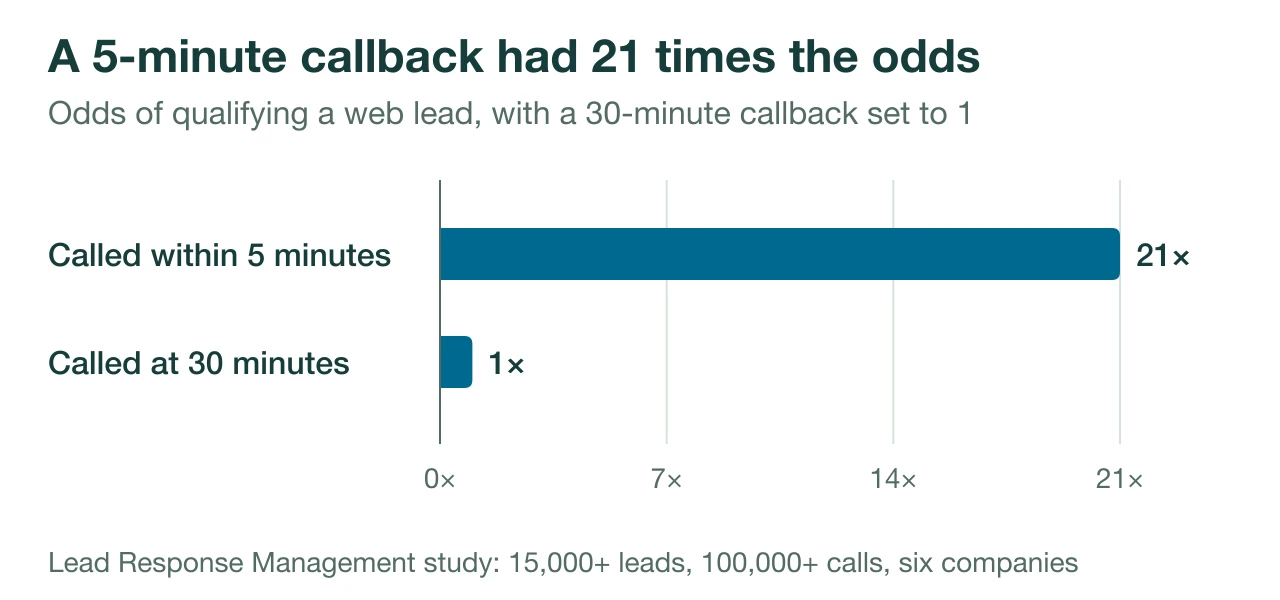
- Reply fast. In one study of more than 15,000 leads, calling back within 5 minutes instead of 30 gave 21 times the odds of qualifying the lead.
- Text when you need to be seen quickly, call to talk through scope, and email to put the price and next steps in writing.
- Leads with a specific scope earn up to eight touches. Vague ones get two.
- Stop after three unanswered attempts across two channels, then send one check-in a few months later to the leads that had a real scope and budget.
How quickly should you follow up with an online lead?
It depends on how the lead arrived:
| Lead type | First reply | First move |
|---|---|---|
| Missed call | Within 15 minutes | Call back, text if no answer |
| Website form | Within 5 minutes, an hour at most | Text, then call |
| Quote request | Same day, within the hour if you can | Call with the range |
Answer calls live whenever you can. The rush is about reaching people at all. Researchers working with InsideSales.com went through more than 15,000 leads and 100,000 call attempts at six companies. Over the first hour after an inquiry, contact success fell more than tenfold and qualification more than sixfold, and calling at 5 minutes instead of 30 gave 21 times the odds of qualifying the lead. When Harvard Business Review audited how companies answer web leads, the authors concluded that "most companies are not responding nearly fast enough."
A quote request is the easiest to answer quickly when it already carries the details. If homeowners request a quote through an estimator on your own site, like QuoteWillow, they've described the project and seen a preliminary range before you reply. Your same-day answer can start with a number instead of "when can you come out?"
How often should you follow up with a lead who hasn't responded?
No number of touches is right for every lead. A form fill with project details deserves more attempts than a one-line "how much for a bathroom?" Set the sequence by where the lead came from, then adjust it as they reply or don't.
Missed calls
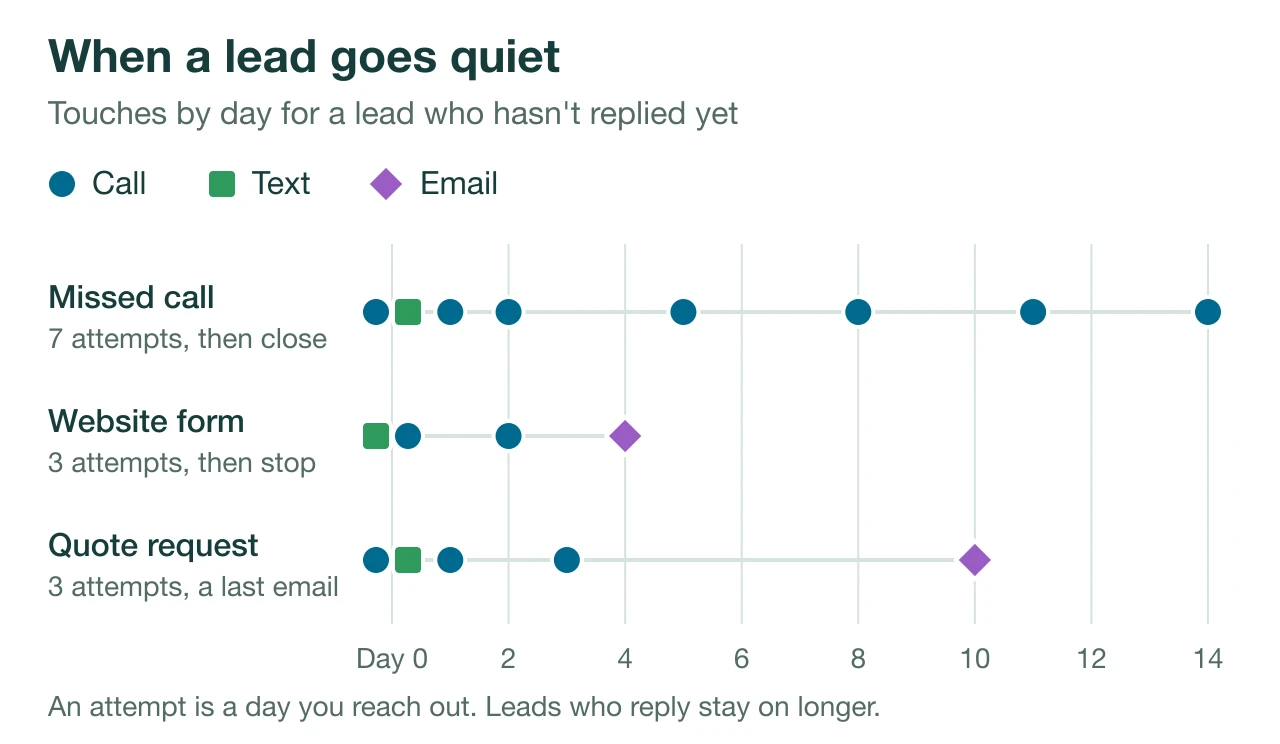
Call back within 15 minutes and send a text in the same hour. If they don't pick up, call once a day for the next two days, then twice a week for two weeks. Someone who picked up the phone to call you has already shown more intent than someone who filled in a form, so they earn more persistence.
Website forms
Text within minutes and call right after, then try again on day 2 and day 4. If they replied or opened your email along the way, add a touch on day 8 and two more after it, a few days apart. Three attempts with no response at all tell you where the lead stands.
Quote requests
A quote request is your best lead. Call within the hour with a preliminary range based on the scope they gave you. If they don't answer, text the same day with the range and two times you could come out to look. Call again the next day, and on day 3 offer the site visit, since people who go quiet after seeing a ballpark often want the number firmed up before they commit. If three days of touches get no reply, send one email a week later, then stop. If they are replying, stay in touch every two to three days for two weeks.
Which channel should you use for each follow-up attempt?
Text when you need to be seen quickly, call to talk through scope, and email to put things in writing.
Text first for form fills
Nine in ten US adults own a smartphone, according to Pew Research Center's 2026 survey, so almost every lead you get can receive a text. Send two sentences, like "Got your request, I'll call you this afternoon," as soon as the form comes in and before you call. Text only people who gave you their number to hear back, and stop the moment someone asks you to.
Call to talk through scope
Scope conversations happen by voice. A homeowner who sent you project details expects to talk about the preliminary range, so call within the hour and let the text warm them up. If they don't pick up, leave a voicemail that names the project.
Email to recap and keep a record
Email carries what a call can't: the price recap, photos, and material options they can forward to a spouse. Send it the same day as the call, with the scope and next steps. When a lead goes quiet, email is also the least intrusive way to nudge them later.
How should follow-up differ for quote requests and general inquiries?
Quote requests: lead with the ballpark
Someone who filled in a quote request gave you project details, so treat your first follow-up as a working estimate. Open with the preliminary range, then book the site visit that firms it up.
General inquiries: qualify before you spend time
"Can you do a bathroom?" is not a quote request. Reply the same day with one or two qualifying questions about service area, a rough budget and timeline, and wait for answers before you offer anything more. Two or three exchanges over a week or two show you whether they're serious. Once they answer the scope questions, treat them like a quote request and put together a preliminary estimate. If you'd rather your form ask for scope up front, contact form vs. project estimator covers what to ask.
What signals tell you a lead is worth a longer follow-up sequence?
Strong signals that justify more touches
A lead who describes a specific scope, like "gut the 8 by 10 hall bath, curbless shower, keep the window," is worth up to eight touches. So is anyone who names a realistic budget range, gives a start month, or agrees to a site visit on a set date. A question about a line item in your estimate is the strongest signal of all, because they're working out whether they can say yes. If one of these leads goes quiet, keep a weekly touch going until they answer.
Weak signals that say stop early
"Can you give me a ballpark?" with no address, scope or timeline usually comes from someone pricing several crews. The same goes for a disconnected phone number or an address outside your service area. Give those two touches and move on. An estimator on your site makes this call easier, because the request arrives with its scope and a preliminary range, and you can judge the lead before you reply.
When should you stop following up with a lead?
Hard stop rules
Stop at whichever comes first: a set number of unanswered attempts or a set amount of time. For form fills and quote requests, three unanswered attempts across two channels is enough, counting each day you reach out as one attempt. A homeowner who asked for a quote and went quiet after three touches usually isn't ignoring you on purpose. They aren't ready yet. Add a time limit too: if the scope never got defined, or the preliminary range came in over their budget, close the file after two weeks. Vague leads show themselves early, so don't spend a fourth touch confirming it.
One last check-in, months later
A closed lead can still come back. Flag the ones that had a real scope and a real budget conversation, and a few months later send one seasonal check-in: two lines that mention their project, maybe a photo of a recent job, and no ask beyond "Still thinking about it?" Send it once. If it goes unanswered, the file stays closed until they come back on their own.
How do you follow up without sounding pushy?
Follow-ups feel pushy when every one asks for something and gives nothing back. Make each touch carry something new about their project: a ballpark for the size they described, a photo of a similar tile job you finished last spring, or a heads-up on material lead times before they commit. That's easier when you collected the scope up front, because your message can name their project instead of saying "just checking in."
End every follow-up with an easy way out: "If you've gone another direction, no hard feelings, just let me know." Taking the pressure off often gets you a faster answer, even when the answer is no.
What tools handle lead capture and follow-up for small contractors?
Where QuoteWillow fits, and where it doesn't
QuoteWillow handles the front of the job. It replaces the contact form on your existing website: homeowners answer your qualifying questions, can see a visual concept, and get a preliminary range calculated from your Price Book, so the lead reaches you quote-ready instead of as a bare form fill. Its questions also screen out tire-kickers before they reach your phone. QuoteWillow is free for 30 days, then $75 a month for up to 25 plan reviews, which suits an owner-operator's inquiry volume.
It doesn't run a follow-up sequence for you. If a lead goes quiet after seeing the estimate, the calls and texts are still yours to make, and if you want automated nudges, that's a real gap.
Tools with follow-up built in
Jobber can follow up automatically by email or text when a client hasn't responded to a quote, and its pricing page lists that from the Connect plan up. QuoteIQ sends email and text automations when an estimate is created, accepted or declined, on its Pro plan and above. Builder Prime advertises automated texts to new leads and automated lead follow-ups. If automated follow-up matters more to you than quote-ready leads, look at those first. If unqualified inquiries are eating your evenings, start with capture. Either way, check the consent rules for marketing texts where you work before you switch on automated ones.
For more on judging leads by what they cost per signed job, see home improvement leads, judged by cost per closed job. To see the homeowner side, walk through how QuoteWillow works or the demo.
FAQ
Is it better to call or text a new lead first?
Text first for website forms: a short note gets seen quickly and sets up the call you make right after. Call first for missed calls and quote requests, because scope is easier to talk through, and leave a voicemail that names the project if they don't answer. Email the recap the same day.
How many times should I contact a lead before giving up?
For form fills and quote requests, stop after three unanswered attempts across two channels, then send one check-in a few months later if the lead had a real scope. Leads that give you a specific scope, a budget range or a visit date earn up to eight touches. Vague ones get two.
What's the best time of day to follow up with homeowners?
Right after the lead comes in matters more than the hour. In the Lead Response Management study, calls between 4 and 6 PM reached people most often, and 8 to 9 AM and 4 to 5 PM were best for qualifying them. Those leads came from six companies, so test the hours against your own.
Should I send pricing in the first follow-up?
For a quote request, yes: lead with a preliminary range based on the scope they sent, then book a site visit to firm it up. For a vague inquiry, ask about service area, budget and timeline first, and build an estimate only after they've answered the scope questions.
Sources
- Lead Response Management study, James Oldroyd with InsideSales.com, study summary.
- James B. Oldroyd, Kristina McElheran and David Elkington, "The Short Life of Online Sales Leads", Harvard Business Review, March 2011.
- Pew Research Center, "Mobile Fact Sheet", October 19, 2026.
- Jobber, pricing, checked November 8, 2026.
- QuoteIQ, email and text automations, checked November 8, 2026.
- Builder Prime, text messaging, checked November 8, 2026.