
Harvard Business Review lead response time: what the study found
In 2011, Harvard Business Review published an audit of how 2,241 US companies answered a web lead. Only 37% replied within an hour, and the average reply took 42 hours. The "391% more likely to convert" figure pinned on the study comes from a different source. Here's what the audit found, and how fast a remodeler should reply.
Key takeaways
- The 2011 HBR audit of 2,241 US companies found that only 37% replied to a web lead within an hour. Among companies that replied within 30 days, the average reply took 42 hours.
- In a separate study of 1.25 million leads, reported in the same HBR article, firms that tried to reach a lead within an hour were nearly seven times as likely to qualify it as firms that waited an hour longer, and more than 60 times as likely as firms that waited a day or more.
- 47% of the companies took more than a day to reply or never replied at all.
- The 391% figure comes from a 2010 analysis by the lead management vendor Leads360 (later Velocify), not from HBR.
- A small remodeler should aim to reply within an hour during working hours, even if the reply is a ballpark range and one question about scope.
What did the Harvard Business Review lead response time study find?
James Oldroyd, Kristina McElheran and David Elkington sent a web test lead to 2,241 US companies and timed each company's reply. They published the results in Harvard Business Review in March 2011 as "The Short Life of Online Sales Leads," alongside findings from a second study of their own, and their summary was blunt: "most companies are not responding nearly fast enough."
The article's own chart breaks the replies down by hour:
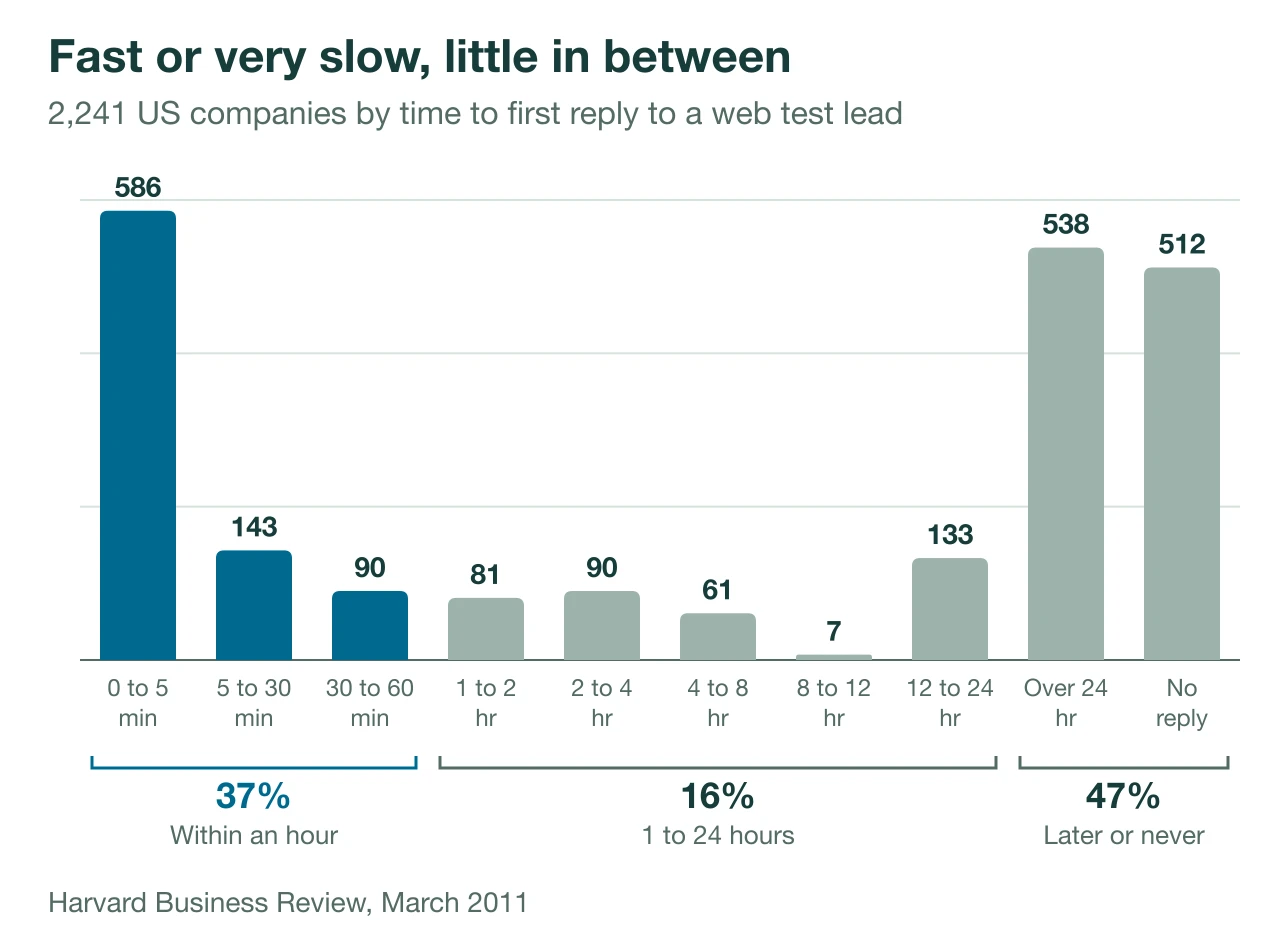
Most of the fast replies came in the first five minutes: 586 companies, about a quarter of the audit. The article doesn't say how many of those were automatic. At the other end, 538 companies took more than a day and 512 never replied, so 47% left the lead waiting a day or longer. The 42-hour average counts only the companies that replied within 30 days, so the companies that never replied would make the real picture worse.
The authors gave three reasons companies were slow: they pulled leads from their CRM databases once a day instead of continuously, their sales teams focused on leads they generated themselves, and they routed leads among agents and partners by geography and "fairness." The first one is the contractor's version of checking the inbox once a night.
How much did a fast reply help?
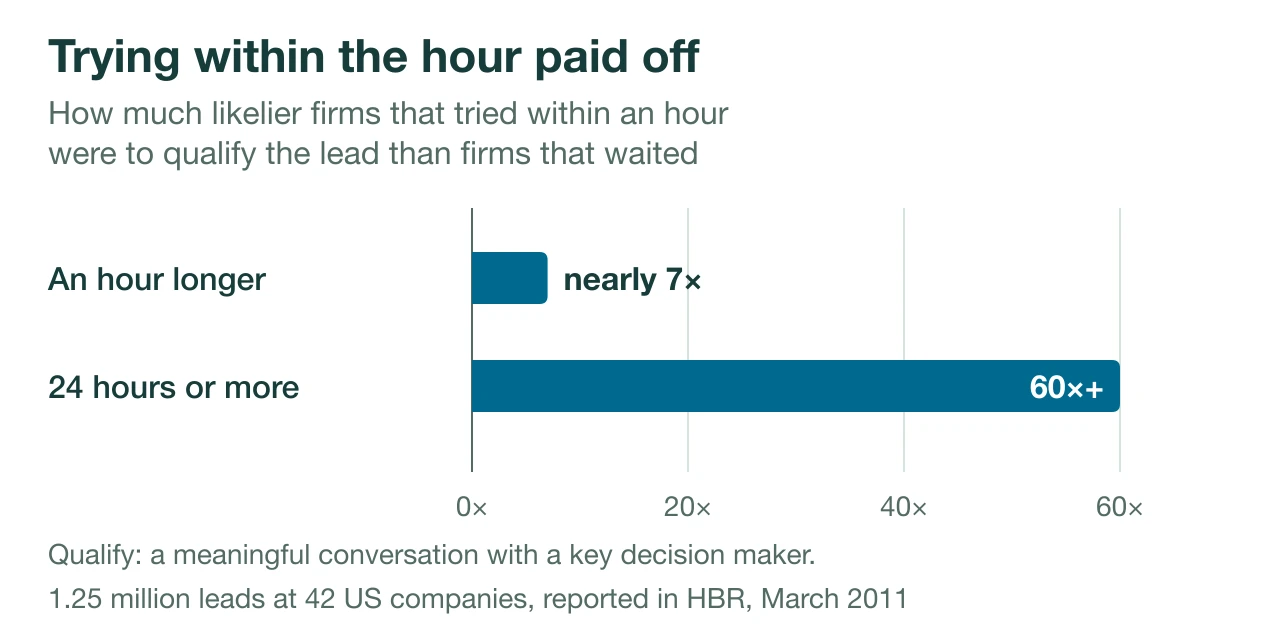
The audit only timed replies. To see what a slow reply costs, the same article draws on the authors' separate study of 1.25 million sales leads received by 42 US companies (29 selling to consumers and 13 to businesses). It defined qualifying a lead as "having a meaningful conversation with a key decision maker." Firms that tried to contact the lead within an hour were nearly seven times as likely to qualify it as firms that tried even an hour later. Against firms that waited 24 hours or longer, they were more than 60 times as likely.
For an owner-operator, a lead you call back tomorrow may have talked to someone else by then, and a homeowner who has heard a ballpark from one crew and booked a site visit is hard to win back. That's why QuoteWillow shows the homeowner a preliminary range from your prices as soon as they describe the project, so your first answer doesn't wait until you're off the job.
Is the "391% more likely to convert" statistic from HBR?
No. The HBR article reported response times from the audit and qualification rates from the authors' lead study. It never published a 391% figure.
Where the 391% figure comes from
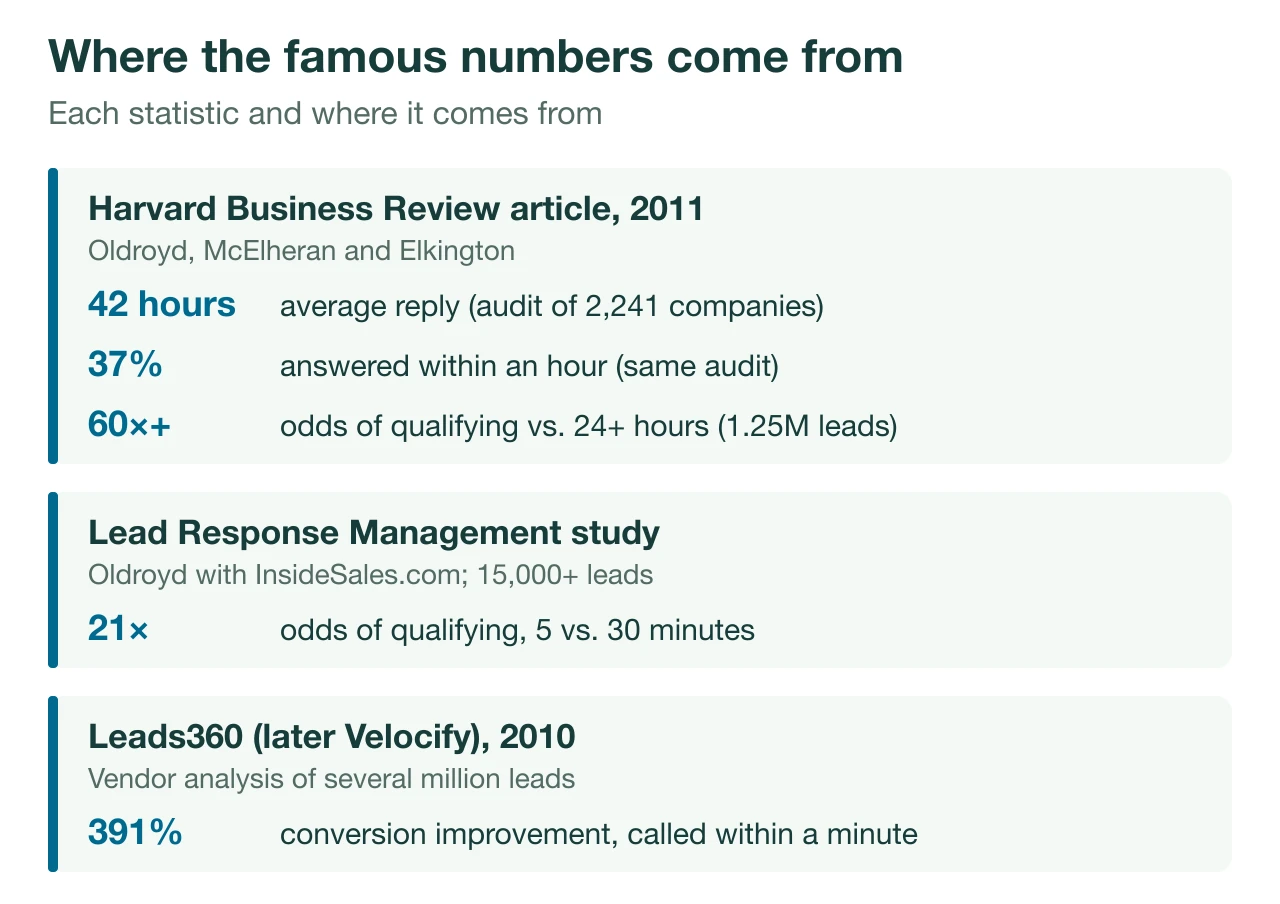
The number traces to Leads360, a lead management software company later renamed Velocify. In a sponsored 2010 piece in Insurance Journal, Leads360 said it had analyzed several million leads and that "companies who were responding to their leads within one minute of receipt were able to achieve 391% improvement." The piece measured lead conversion and never said what the improvement was measured against. Treat it as a vendor's finding with an unstated baseline.
Why the numbers got mixed up
The HBR article is short, well known and easy to link, so writers attached the more dramatic number to the better-known name. For deciding how fast to call a lead back, the attribution matters less than the pattern the studies share: whoever reaches the homeowner first has the best shot at the job. That's the case for answering an inquiry with something useful, like a preliminary range, before a competitor calls. How QuoteWillow works shows what that looks like on your own site.
What does speed to lead mean for a contractor who sells their own jobs?
Speed to lead is the time between a homeowner sending an inquiry and your first contact. When you price and sell your own jobs, that time depends on you. There's no office staff to pick up the phone while you're on a ladder.
Why the first caller usually gets the site visit
If a homeowner sends the same request to several contractors, the first one to call back sets the terms. That contractor asks about scope, floats a range and books the site visit. The next contractor to call finds the homeowner already has a time on the calendar with someone else. Whatever the first contractor quoted, cheap or not, becomes the number the others get measured against.
Homeowners build the shortlist fast
A homeowner who hears back from two contractors the same evening has little reason to wait for a third. The contractors who answered get the first conversations, and anyone slower becomes a backup. If you're on a job site all day, an estimator on your website can collect the project details and give the homeowner a range while you work, so a 5 p.m. callback starts from a plan. Get in touch if you want to see how that works.
How does the HBR research compare to other lead response studies?
The HBR audit tested how fast companies answered, and the authors' lead study tested what a slow answer costs. Another study led by Oldroyd, the Lead Response Management study done with InsideSales.com, looked at the first minutes. It covered more than 15,000 leads and 100,000 call attempts at six companies and found that calling at 5 minutes instead of 30 gave 21 times the odds of qualifying the lead. The studies used different methods and reached the same conclusion: response times are slow, and the fast responders get the conversations.
The practical lesson holds across all of them. A ballpark range sent the same day beats a polished estimate sent three days later. QuoteWillow is built around that: homeowners on your site see a preliminary range before you pick up the phone. See how it works for contractors.
Where the research is thin
These studies measured web forms at sales organizations, not trade inquiries that depend on site visits and seasonal demand. We haven't found a published study of response times for residential remodelers. One of the HBR authors, David Elkington, was chairman and CEO of InsideSales.com, the sales software company behind the Lead Response Management study. Treat the benchmarks as a direction, and judge your own results by the estimates you book.
What response time should a small remodeler actually aim for?
Under an hour during working hours
In the lead study HBR reported, the firms that tried within an hour qualified far more of their leads. For a shop with one to ten crew members, that becomes a simple rule: any inquiry that arrives while you're at a computer or between jobs gets a reply within the hour. After hours, first thing the next morning is fine, as long as the preliminary range reaches the homeowner before lunch.
A two-line email with a ballpark and a question about scope is enough, and it does more for you than a voicemail that says nothing.
What to do when you're on a job site
You can't answer the phone in the middle of an install, so tell the homeowner when you'll get back to them. An auto-reply like "I'm on a job site until 3. I'll send you a preliminary range today" keeps them from filling out three more forms.

Software can carry some of the load. QuoteWillow's estimator sits on your existing website, collects the project details and gives the homeowner a preliminary estimate from your Price Book while you're working. A homeowner who sees the range can decide whether the project still makes sense before you call back. No tool answers scope questions as well as you do, though.
How can you respond faster without hiring anyone?
Most of the delay comes from getting the scope out of the homeowner's head and into yours, and much less from writing the estimate. If they can describe the project the moment they land on your site, the site visit or plan review becomes your second contact instead of your first.
Capture project details when the inquiry comes in
A short form on your site that asks for project type, rough dimensions, photos and ZIP code does two jobs. It screens out people who are only browsing, and it gives you enough to quote a preliminary range before you call back. A lead that arrives with a scope attached takes ten minutes to answer. A "just checking prices" voicemail can take days of back and forth.
Other tools that help you answer faster
Field-service and CRM tools approach the problem from the follow-up side. Jobber can follow up automatically by email or text when a client hasn't responded to a quote, from its Connect plan up. QuoteIQ sends email and text automations when an estimate is created, accepted or declined, on its Pro plan and above. Builder Prime advertises automated texts to new leads. If automated follow-up is your bottleneck, look at those. If unqualified inquiries are eating your evenings, start with capturing the scope. We compared the follow-up side in more detail in how to follow up with leads.
QuoteWillow is free for 30 days, then $75 a month for up to 25 plan reviews (pricing). If you need more than 25 a month, ask about custom volume.
Where QuoteWillow falls short
QuoteWillow handles the first contact: the estimator on your site, the preliminary range and the inquiry that reaches you. It doesn't schedule crews or send invoices, so you'll still need a field-service tool once the job is sold.
How do you know if slow follow-up is costing you jobs?
Track the time to first contact for two weeks
Write down when each inquiry arrives and when you first reply, whether by call, text or email. Two weeks is enough to see your real pattern. If most first replies happen hours later because you were on a job site or under a porch, you have a number to work with instead of a hunch.
Separate the browsers from the real projects
Not every lost lead is a follow-up problem. Tag each inquiry as someone just browsing, someone shopping for a ballpark, or a serious conversation about scope, then check which ones went quiet. If the serious buyers went cold before your site visit, slow replies are costing you jobs. If only the ballpark shoppers disappeared, your follow-up is fine and your pricing is doing the screening.
FAQ
Did HBR really say companies that respond within an hour are 7x more likely to qualify a lead?
Nearly, and the figure comes from the authors' study of 1.25 million leads, not from the audit of 2,241 companies. Firms that tried to contact a lead within an hour were nearly seven times as likely to qualify it as firms that tried an hour later. The comparison is against a reply one hour slower, not against the 42-hour average, and "qualify" meant a meaningful conversation with a key decision maker.
Where do the 391% and 60x lead response statistics come from?
The 60x figure is from the 2011 HBR article, which reported it from the authors' study of 1.25 million leads: firms that tried within an hour were more than 60 times as likely to qualify the lead as firms that waited 24 hours or more. The 391% figure is from a 2010 Leads360 analysis of leads called within one minute, and Leads360 didn't publish the baseline it was measured against. Only the 60x figure belongs to HBR.
How fast should a contractor call back an internet lead?
Within an hour during working hours. Only 37% of the companies in the HBR audit managed that. If an inquiry arrives while you're on a job site, send a two-line reply with a ballpark and a scope question, then call the same evening.
Does responding to a lead in minutes really matter, or is same-day fine?
Minutes matter more than most owners expect. In the HBR audit, 586 of the 2,241 companies, about 26%, replied within five minutes. In the Lead Response Management study, a call at 5 minutes had 21 times the odds of qualifying the lead compared with a call at 30 minutes. Same-day is far better than the 42-hour average, but by the evening the homeowner may already have a site visit booked with someone else.
What did the HBR lead response audit say about companies that never responded at all?
23% of the 2,241 companies never answered the test lead, and another 24% took more than a day. That means nearly half left the lead waiting a full day or longer. An owner-operator who replies within the hour is ahead of most of the companies in the study.
Sources
- James B. Oldroyd, Kristina McElheran and David Elkington, "The Short Life of Online Sales Leads", Harvard Business Review, March 2011, p. 28 (HBR Reprint F1103B).
- Lead Response Management study, James Oldroyd with InsideSales.com, study summary.
- Leads360, "How Quickly Should You Call Insurance Leads?", Insurance Journal NewsWire (sponsored content), June 14, 2010.
- Jobber, pricing, checked November 8, 2026.
- QuoteIQ, email and text automations, checked November 8, 2026.
- Builder Prime, text messaging, checked November 8, 2026.