
The basics of job costing: a line-by-line walkthrough

Job costing comes down to one habit: tracking what a single job actually cost you in labor, materials and overhead, then comparing it to what you quoted. This walkthrough costs one $14,000 bathroom remodel line by line, so you can see where every number comes from and run the same profit check on your next job.
Key takeaways
- Job costing tracks labor, materials and overhead for a single job, then compares actuals to the quote so you know which job types make money.
- Price labor at a loaded rate, not the wage on the check. In June 2026, private employers paid about 43 cents in benefits and payroll costs for every dollar of wages.
- Allocate overhead as a percentage of direct cost or as a rate per labor hour, pick one, and build it into your Price Book.
- Comparing estimate to actuals line by line turns every overrun into a specific fix, like pricing a subfloor allowance into the next bathroom quote.
- Job costing fails when nobody tracks time, the scope is vague, or unqualified inquiries eat your estimating hours. Daily hour reports and written scopes fix the first two.
What is job costing, in plain terms?
Job costing means tracking every dollar a single job spends: labor hours, materials, and its share of overhead like insurance, truck costs and office time. Instead of asking "did the year make money?", you ask "did last month's bathroom remodel make money?" The costs are the same ones already in your books. Job costing assigns them to specific jobs instead of lumping them together, and that's what separates a real preliminary estimate from a ballpark pulled from the last similar job.
Why should a small remodeler bother with job costing?
Because gut feel is unreliable. Most owner-operators can tell you their year made money, but not which job types did. Once you cost each job, you might find kitchen remodels clearing 28% while basement finishes limp along at 9%, and that changes what you quote next season.
Job costing also sharpens your preliminary estimates. If your last three tile showers ran over on labor hours, your next ballpark gets more honest, and you stop eating the difference on jobs you underpriced.
It matters for selling, too. If you use an online estimator, like QuoteWillow's, the range a homeowner sees is only as good as the labor rates and unit prices behind it. Real costs make that range hold up when the homeowner asks questions.
What goes into the cost of a single job?
Every job's cost lands in one of three buckets: direct labor, materials and subs, and a slice of overhead. Get the buckets right and the math in the worked example becomes mechanical.
Direct labor
Direct labor is every hour your crew spends on this scope, priced at a loaded rate rather than the wage on the check. The load is the part most owner-operators skip. Wages are only the starting point: payroll taxes, workers' comp, health insurance and paid time off sit on top.
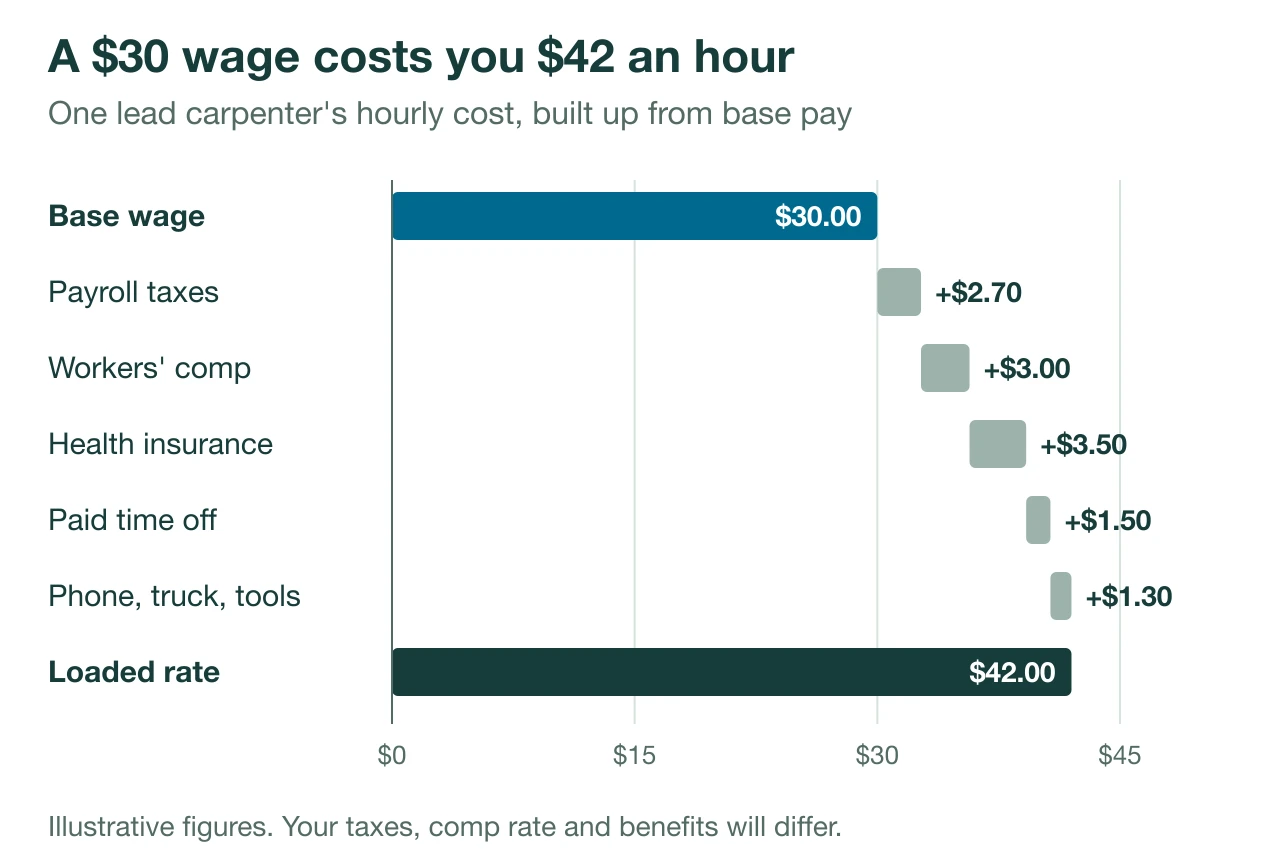
For scale, the Bureau of Labor Statistics found that in June 2026, private employers paid $14.07 an hour in benefits on top of $32.82 an hour in wages. That's about 43 cents per wage dollar, and it includes Social Security, Medicare, unemployment insurance and workers' comp. If you pay a lead carpenter $30 an hour and skip the load, the hour can really cost you $42, and the difference shows up as profit that isn't there. The loaded rate section below works through that number line by line.
Materials and subcontractors
Materials are the tile, fixtures, lumber, fasteners and dump fees tied to this job, priced from your supplier quotes or your Price Book. Subcontracted work, like a plumber on a bathroom remodel, counts here too, at the number on their invoice, not your guess.
Overhead
Overhead is everything that keeps the trucks rolling whether or not a job exists: insurance, software, shop rent, and your own unbillable hours selling and reviewing plans. You don't assign it directly. You spread it across jobs, as the overhead section below explains.
How do you calculate a loaded labor rate?
Start with base pay and add what rides on top of it:
- Payroll taxes. Employer Social Security and Medicare are 7.65% of wages (6.2% plus 1.45%). Federal and state unemployment taxes add a little more on the first part of each worker's pay; the federal tax applies to the first $7,000.
- Workers' comp. It varies by trade and state, and carpentry costs more to cover than office work.
- Benefits and allowances. Health insurance, paid time off, and any phone, truck allowance or small tools you cover.
Say a lead carpenter earns $30 an hour. Payroll taxes at about 9% add $2.70. Workers' comp adds $3.00, health insurance $3.50, paid time off $1.50, and phone, truck and tools $1.30. That's $42.00 an hour, 40% over the wage.
Run this for each person, then average across the crew. A lead at $42 loaded and a helper paid $22 who loads to $27.50 average $34.75 an hour. That's the labor rate your Price Book should carry, not $26, the average of their wages.
Worked example: costing a $14,000 bathroom remodel line by line
Here is a hall bathroom remodel, priced at $14,000, costed from estimate to final profit check. The numbers are illustrative, not from a real job. If you set up jobs in your bookkeeping software, this is the same structure you'd use; QuickBooks Online, for example, tracks jobs as Projects on its Plus and Advanced plans.
Step 1: Estimate labor hours and materials
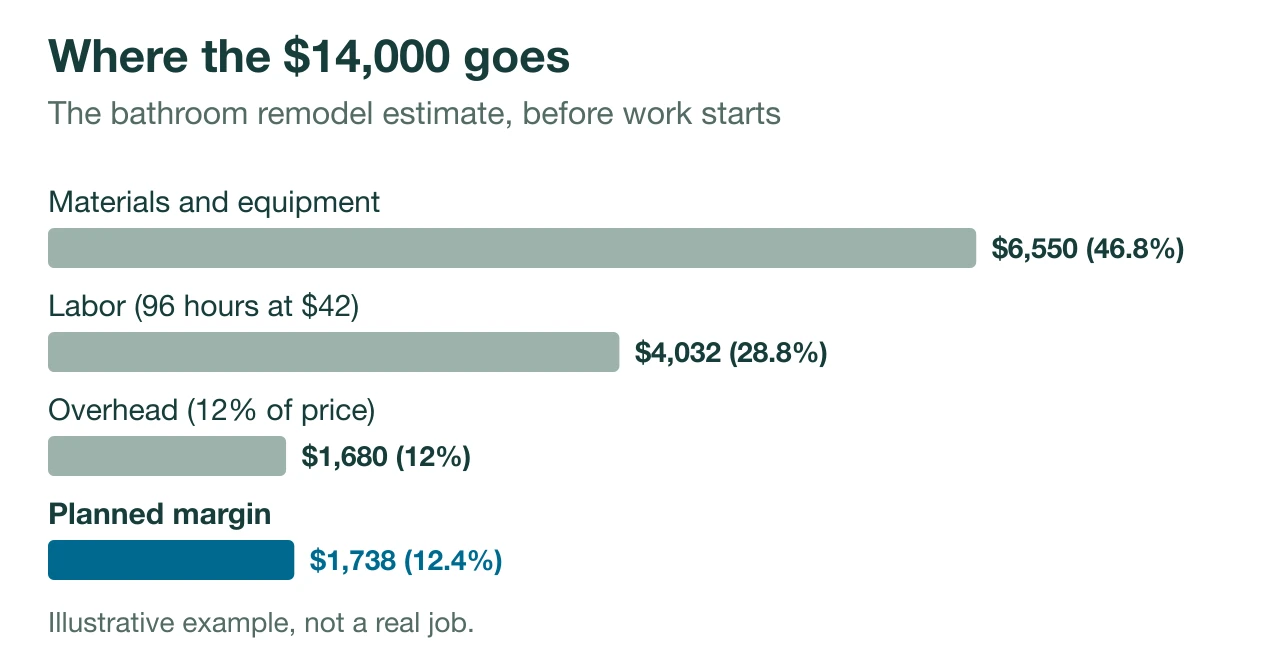
Materials: tile and setting materials $1,800; vanity, toilet, tub and fixtures $3,200; backer board, drywall and plumbing supplies $1,200. That's $6,200. Dump trailer and equipment rental adds $350. Labor: two carpenters for six eight-hour days, 96 labor hours in all.
Step 2: Apply the loaded labor rate
Both carpenters are lead-level, at the $42 loaded rate from the previous section. 96 hours × $42 = $4,032. Direct cost so far: $6,200 + $350 + $4,032 = $10,582.
Step 3: Allocate overhead to the job
If your annual overhead is $48,000 and you bill $400,000 a year, overhead is 12% of revenue. On a $14,000 job that's $1,680. Total estimated cost: $10,582 direct + $1,680 overhead = $12,262, which leaves a planned margin of $1,738, or 12.4%.
Step 4: Compare estimate to actuals
| Line | Estimate | Actual | Difference |
|---|---|---|---|
| Materials | $6,200 | $6,750 | +$550 |
| Dump trailer and equipment | $350 | $410 | +$60 |
| Labor at $42 an hour | 96 hours, $4,032 | 104 hours, $4,368 | +$336 |
| Overhead (12% of price) | $1,680 | $1,680 | $0 |
| Total cost | $12,262 | $13,208 | +$946 |
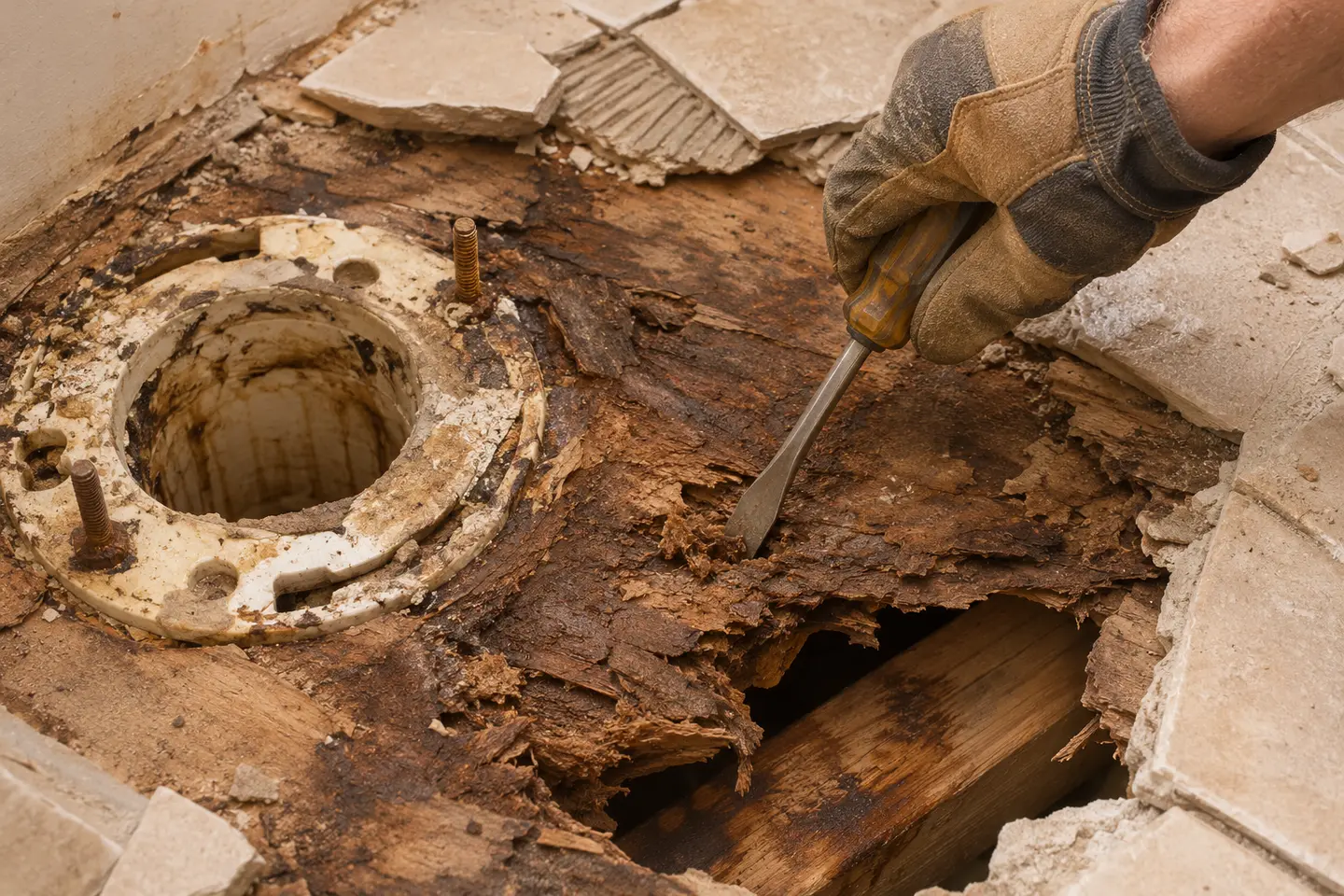
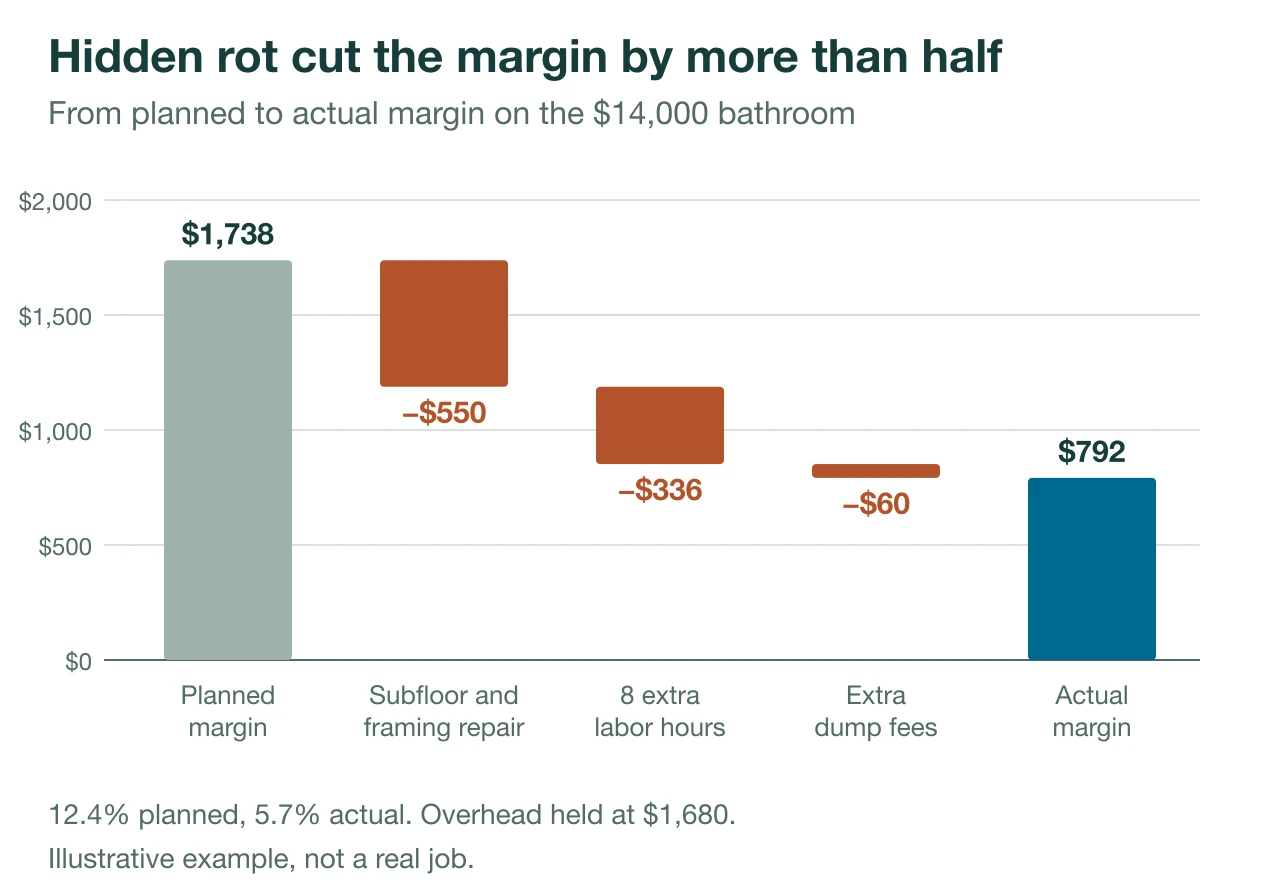
When the toilet came out, the subfloor around the flange was soft, and the rot ran into a joist. Replacing the subfloor and sistering the joist took $550 in materials and 8 extra labor hours, and the extra debris added $60 in dump fees. That's the point of the comparison: the job ran $946, or 7.7%, over its estimated cost, and it tells you a fixed price was tight for an older bathroom with a toilet that may have leaked.
Step 5: The final profit check
Revenue of $14,000 minus the actual cost of $13,208 leaves $792, a 5.7% margin instead of the planned 12.4%.
Working faster wouldn't have fixed this. Pricing a subfloor allowance into the next bathroom quote would, or writing the estimate to exclude concealed damage until the floor is open, with a set price for repairs if you find it.
How much overhead should each job carry?
The bathroom example used the simplest version: a year of overhead divided by a year of revenue, $48,000 ÷ $400,000 = 12% of every price. Two other methods tie overhead to the work in the job instead:
- Percentage of direct cost. Divide a year of overhead by a year of direct costs (labor, materials and subs). If the same company's direct costs run $300,000, overhead is 16% of direct cost, and the bathroom's $10,582 carries $1,693.
- Rate per labor hour. Divide a year of overhead by the labor hours you bill. At 3,200 hours a year, that's $15 an hour, and the bathroom's 96 hours carry $1,440.
The hourly method puts more overhead on labor-heavy jobs, which fits if a three-week job really ties up more of your business than a two-day repair. The bathroom is heavy on materials, so it carries less under that method. Whichever you pick, use it on every estimate so margins stay comparable job to job, and build it into the labor rates and unit prices in your Price Book so the preliminary range you quote already covers it.
One trap: 12% of the price isn't the same as adding 12% to cost. Adding 12% to the bathroom's $10,582 direct cost gives $1,270, not $1,680.
How do you run the profit check after the job wraps?
Pull the actuals: every material receipt, every crew hour from your time records, and any subcontractor invoices. Set them beside the estimate line by line, the way the table above does.
Each variance points at a fix. A materials overrun usually means the takeoff missed something, so add that line to the next similar job. A labor overrun usually means site conditions or scope you didn't see until the work started. In the bathroom, both came from the same rotted subfloor.
Update your Price Book with the real unit costs. If the job still hit your target margin, the estimating method works. If it missed, the variance tells you which line to change before you price the next one.
Where does job costing break down for owner-operators, and what fixes it?
Job costing fails in three predictable spots.
First, nobody tracks time, so the labor numbers on your next estimate are guesses. Have crews text their hours per job every day. Even a photo of a whiteboard works.
Second, the scope was vague, so material costs drift and the profit check shows a loss you can't explain. Write the scope into the quote itself, line by line, before you price it.
Third, and costliest, unqualified inquiries eat your estimating hours. You spend an evening on a preliminary estimate for someone who was never going to buy. Filter before you invest that time. QuoteWillow, for example, captures the project details and gives visitors a preliminary range based on your Price Book, so the inquiries that reach you are quote-ready and worth a site visit. Whatever tool you use, spend your estimating hours on jobs that can actually close.
FAQ
What is an example of job costing for a contractor?
A $14,000 bathroom remodel estimated at 96 labor hours at a $42 loaded rate ($4,032), $6,550 in materials and equipment, and 12% overhead ($1,680), for a total cost of $12,262 and a 12.4% margin. Rotted subfloor added $946, so the actual cost came to $13,208 and the margin fell to 5.7%.
How do you calculate overhead cost per job?
Divide a year of overhead by a base that matches how jobs use it. As a percentage of direct cost, $48,000 of overhead on $300,000 of direct costs is 16%. As an hourly rate, $48,000 over 3,200 billable labor hours is $15 per labor hour. Pick one and apply it to every estimate.
Is job costing the same as process costing?
No. Job costing tracks costs for one specific job, like a single bathroom remodel, so you know whether that project made money. Process costing spreads costs across continuous, identical production runs, which suits manufacturers, not contractors. If your work varies job to job, job costing is the method that fits.
What percentage should overhead and profit be on a remodeling job?
You'll often hear "10 and 10," meaning 10% overhead and 10% profit, but your own numbers matter more. If your overhead runs 12% of revenue, as in the bathroom example, a combined 20% leaves about 8% for profit before anything goes wrong on site. Work out your real overhead rate first, then set profit on top so the two don't blur together.
Do I need software to do job costing, or can I use a spreadsheet?
A spreadsheet handles the math fine: list labor, materials and overhead per job, then compare estimate to actual. Our Excel construction estimate template is a starting point. Software earns its keep on time tracking and on reporting across many jobs, which is where bookkeeping tools like QuickBooks Online's Projects come in.
Sources
- U.S. Bureau of Labor Statistics, "Employer Costs for Employee Compensation, June 2026", released September 9, 2026.
- IRS, Topic no. 751, Social Security and Medicare withholding rates, checked November 17, 2026.
- IRS, Topic no. 759, Form 940, federal unemployment (FUTA) tax, checked November 17, 2026.
- Intuit, Change sub-customers into projects in QuickBooks Online, checked November 17, 2026.